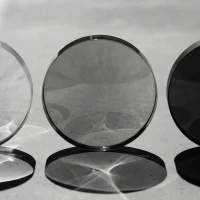
The Science of Sight: Why Eleven Spectacles Chooses ZEISS Optics
Key Takeaways
- Back-surface anti-reflective coating – Eliminates bounce-back glare through 7-9 microscopic layers, increasing light transmission to 99.5%
- Aesthetic purity – Coating applied only to back surface preserves intended lens colour; no green/blue colour cast
- DuraVision hard coating – Molecularly-bonded protection, 3x harder than previous-generation lenses
- Complete UV400 protection – 100% UVA/UVB blockage independent of lens darkness, certified to 400 nanometers
- 180 years of optical mastery – From the first precision microscope (1846) to the Apollo 11 Moon landing cameras
- Vacuum deposition manufacturing – Ion-assisted coating process with 9+ ultra-thin layers of metal oxides
- Frame-lens synergy – Beta-Titanium's shape-memory maintains consistent optical alignment with ZEISS precision
A Legacy Written in Light: 180 Years of ZEISS Innovation
Every coating on an Eleven Spectacles lens has a purpose. Nothing is added without one. The goal is uncompromised visual clarity, and every engineering decision follows from that.
To achieve this, we partner with ZEISS, the historic pioneer whose name has been synonymous with optical precision since 1846. When Carl Zeiss opened his workshop in Jena, Germany, he was not merely crafting microscopes–he was establishing the very methodology of modern optics. By collaborating with physicist Ernst Abbe and chemist Otto Schott, Zeiss transformed lens-making from an art of trial and error into a science of mathematical precision.
The milestones that followed read like a history of human discovery itself. The Abbe Sine Condition (1872) established the mathematical foundation for all modern lens design. The Tessar lens (1902), designed by Paul Rudolph, became the most influential camera lens configuration in history–so versatile that a version still powers smartphone cameras today. The PUNKTAL eyeglass lens (1912), developed with Nobel laureate Allvar Gullstrand, delivered razor-sharp vision into the corners of the lens for the first time.
In 1935, ZEISS physicist Olexander Smakula invented the world's first anti-reflective coating–a breakthrough marked by a red "T" on ZEISS lenses that signified "Transparent." This technology, refined over decades into the multi-layer T✻ (T-star) system, remains the foundation of modern AR coating. When Neil Armstrong stepped onto the lunar surface in 1969, the photographs were captured through ZEISS lenses specially engineered for the harsh environment of space.
This is the lineage integrated into every Eleven Spectacles frame: not merely a supplier relationship, but a convergence of philosophies. ZEISS has always pursued the boundaries of what is optically possible. We pursue the boundaries of what eyewear can be. Together, we create something neither could achieve alone–a finely calibrated optical instrument worn on the face.
The Problem: Back-Glare and the Hidden Cost of Optical Noise
Consider a common scenario: sunlight reflecting off a building behind you, or the sun positioned low on the horizon during morning commutes. In standard sunglasses, light rays strike the back surface of the lens and reflect directly into your eye–a phenomenon optical engineers term "ghost images" or bounce-back glare.
An uncoated lens surface reflects approximately 8% of incident light–4% from the front surface and 4% from the back. This seemingly modest figure creates disproportionate visual consequences. Your pupil enters a state of constant micro-adjustment throughout the day, compensating for invisible light sources. These adjustments seem minor in isolation–a fraction of a millimetre, milliseconds of response time–but they accumulate into what many describe as end-of-day eye fatigue: subtle, persistent, and entirely unnecessary.
Research demonstrates that uncoated lenses create multiple reflection points that scatter light unpredictably, forcing the brain to work harder to filter visual noise. The result: noticeable eye fatigue after 2–3 hours of wear, ghost images in bright conditions, and severe halos around light sources at night. For professional drivers and pilots, AR coating is considered essential safety equipment, not an optional upgrade–the reduced glare measurably improves reaction times during night driving.
The Solution: Back-Surface Anti-Reflective Technology
Our ZEISS lenses feature a specialized Back-Surface Anti-Reflective (AR) Coating–a deliberate engineering choice designed to balance optical function with aesthetic purity.
The Physics of Clarity: Destructive Interference
AR coating operates through destructive interference, a principle of wave physics where reflected light waves are cancelled out by precisely calibrated counter-waves. The coating consists of 7–9 alternating microscopic layers of metal oxides (typically magnesium fluoride, silicon dioxide, and titanium dioxide), each with a different refractive index and each precisely calculated to be one-quarter the wavelength of specific light frequencies.
The manufacturing process is equally precise. Lenses are placed inside a vacuum chamber where vaporized coating particles settle onto the rotating lens surfaces in exact layers–a process called ion-assisted deposition. The lens surface is then bombarded with ions to seal the coating at a molecular level, significantly increasing hardness and scratch resistance.
The results are measurable and dramatic:
| Optical Metric | Uncoated Lens | ZEISS AR-Coated Lens | Improvement |
|---|---|---|---|
| Surface reflections | ~8% (4% front + 4% back) | <0.5% | 94% reduction |
| Light transmission | ~92% | 99.5% | +7.5% |
| Ghost images | Visible in bright conditions | Eliminated | Complete |
| Night halos | Severe around lights | Reduced by 95% | Near-complete |
| Eye fatigue onset | 2–3 hours | Minimal strain | Dramatic reduction |
Internal Clarity
Our specialized multi-layer anti-reflective coating is applied exclusively to the inner lens surface. This absorbs scattered light before it can reflect into your eye, eliminating bounce-back glare entirely. The technical result is optical clarity: just the image you intend to see, nothing more.
Your pupil remains stable. Your eye experiences no fatigue from invisible light sources. The world remains sharp and undistracted.
External Purity
We deliberately choose not to apply coating to the front surface. While front-surface anti-reflective coatings reduce external reflections, they introduce a subtle colour cast (typically green or blue) that compromises the visual identity of the frames. By keeping the front surface untreated, we honour the aesthetic intention of the lens design–its intended depth and richness–while all optical clarity occurs invisibly, from within. The wearer sees clarity; the world sees beauty.
The Invisible Shield: DuraVision Hard Coating Durability
Precision optics demand protection. A microscopic scratch on a lens is not merely cosmetic–it is an optical failure. It scatters light, introduces aberrations, and degrades the clarity you invested in.
To safeguard this clarity, our lenses are fortified with ZEISS DuraVision premium hard coating: a transparent, ultra-dense layer bonded to the lens substrate at a molecular level. This is not a surface treatment–it is a structural integration that significantly increases resistance to micro-abrasions from cleaning cloths, dust particles, and daily handling.
The DuraVision Coating Architecture
The DuraVision system is a sophisticated multi-layer platform:
| Layer | Function | Technology |
|---|---|---|
| Hard coating base | Scratch resistance | Thermally cured, denser than lens material |
| AR coating stack | Glare elimination | 7–9 anti-reflective layers |
| Anti-static layer | Dust repulsion | Prevents particle adhesion |
| CleanGuard top coat | Smudge/oil resistance | Water and oil-repellent; cleans 3x faster |
Independent testing confirms that DuraVision Platinum coating is 3x harder than the previous generation of plastic lenses and 35% harder than AR-coated glass lenses. The Bayer ratio–a standardized industry scratch-resistance test–consistently achieves results above 10, classified as "very high" durability.
It ensures that the optical clarity you experience on day one remains consistent for years to come.
For guidance on daily lens care, see our product care guide.
Invisible Safety: Absolute UV400 Protection
Our minimalist approach to aesthetics stands in sharp contrast to our absolutist approach to safety. We reject the false equivalence between darkness and protection.
A lens without proper UV filtration, however dark it appears, is a liability–not a safeguard. It causes your pupil to dilate, exposing the eye to dangerous amounts of unfiltered radiation. This is not hypothetical: the World Health Organization estimates that approximately 20% of cataract cases may be linked to UV exposure, and the American Optometric Association connects long-term UV exposure to photokeratitis (sunburn of the eye), pterygium ("surfer's eye"), and macular degeneration.
Understanding the UV Spectrum
Ultraviolet radiation is categorized into three bands based on wavelength:
| UV Type | Wavelength | Atmospheric Filtration | Eye Impact |
|---|---|---|---|
| UVC | 100–280 nm | Absorbed by ozone layer | Negligible terrestrial risk |
| UVB | 280–315 nm | Partially absorbed | Cornea and lens damage; cataracts |
| UVA | 315–400 nm | Reaches surface fully | Retina penetration; macular degeneration |
The UV400 standard signifies that lenses block light rays with wavelengths up to 400 nanometers–the complete spectrum of UVA and UVB radiation that reaches Earth's surface. This is the gold standard recommended by optometrists and ophthalmologists worldwide. Lenses marketed as "100% UV protection" without UV400 certification may only block up to 380nm, leaving a dangerous 20-nanometer gap of high-energy UVA exposure.
Every pair of Eleven Spectacles blocks 100% of UVA and UVB radiation through specialized chemical filtration built into the lens material itself. This protects the retina and the delicate skin around the eyes from long-term photo-ageing and cumulative damage.
This protection is complete, regardless of lens tint intensity or visible light transmission. A clear ZEISS lens provides identical UV protection to a darkly tinted one–the UV filtration operates independently of the tint.
For a detailed explanation of UV wavelengths, lens categories, and tint selection, see our UV protection and lens tint guide.
The Convergence: Frame and Lens as One Optical System
A lens's theoretical perfection means nothing if it is not held in consistent alignment. This is where frame and lens converge into a single optical system.
The shape-memory property of our Beta-Titanium frames ensures that your ZEISS lens remains precisely positioned relative to your pupil. Beta-Titanium's body-centered cubic crystal structure allows the frame to flex under repeated stress–from putting on and removing the glasses, from adjustments, from the small impacts of daily life–and return to its exact original geometry without permanent deformation.
Standard pure titanium has a hexagonal close-packed structure. It is strong, but relatively stiff. Beta-Titanium alloys, created by adding elements such as vanadium, molybdenum, or aluminium, shift the crystal structure to a body-centered cubic form. This change significantly increases elasticity–a property optical engineers call superelasticity or pseudoelasticity.
This structural integrity is the foundation on which precision optics depend. A misaligned lens introduces prismatic distortion, chromatic aberration, and uneven visual fields. Beta-Titanium eliminates this risk by maintaining its geometry indefinitely–the frame becomes an invisible, unwavering platform for optical excellence.
| Property | Beta-Titanium | Standard Titanium | Stainless Steel |
|---|---|---|---|
| Crystal structure | Body-centered cubic | Hexagonal close-packed | Face-centered cubic |
| Elasticity (shape memory) | Excellent | Limited | None |
| Weight | ~18g | ~20g | 28–35g |
| Hypoallergenic | 100% medical-grade | Yes | Often contains nickel |
| Saltwater corrosion | Impervious | Resistant | Pits over time |
ZEISS DuraVision: The Science of the Coating Stack
In 2025, ZEISS extended its coating portfolio with DuraVision Gold UV, representing the premium tier of lens protection. This innovation is relevant to understanding the full capability of the coating technology integrated into Eleven Spectacles lenses.
The DuraVision Gold system integrates CleanGuard technology for the first time–making lenses up to three times faster to clean than previous generations. Spectral engineering reduces reflectance in the blue-light spectrum (380–500 nanometers), resulting in up to 90% lower yellowness compared to conventional blue-green coatings and noticeably enhanced clarity in low-light conditions.
For Eleven Spectacles, we specify a proprietary coating configuration optimized for sunglass applications: maximum scratch resistance, complete UV filtration, and the preservation of lens tint purity. The back-surface AR coating eliminates internal glare while the front surface remains uncoated–preserving the aesthetic depth of our curated lens colours.
Why Eleven Spectacles Chooses ZEISS: A Philosophy of Convergence
The partnership between Eleven Spectacles and ZEISS is not transactional–it is philosophical. Both brands are defined by a refusal to compromise, a belief that the finest instruments should be both invisible and unforgettable.
ZEISS has spent 180 years proving that optical perfection is possible. From the microscopes that revealed cellular worlds to the cameras that documented humanity's first steps on another celestial body, ZEISS has consistently operated at the boundary of what is optically achievable.
Eleven Spectacles pursues a parallel mission in the physical realm: proving that eyewear can be simultaneously weightless and permanent, beautiful and functional, an object of desire and an instrument of clarity. Our Beta-Titanium frames–at approximately 18 grams–achieve a strength-to-weight ratio that rivals aerospace engineering.
When these two philosophies converge, the result is not merely a product. It is a statement about what luxury can mean: not excess, but precision; not decoration, but purpose; not the assertion of wealth, but the elimination of compromise.
That philosophy is also a quiet argument for permanence. A Beta-Titanium frame is made to be worn for decades, not seasons – kept, serviced, and handed on rather than replaced. Longevity is the most understated form of sustainability: one frame, cared for over a lifetime, in place of many discarded.
The Result: Optical Mastery Without Compromise
The result is not merely eyewear. It is a finely calibrated optical instrument: the structural integrity of aerospace-grade titanium combined with 180 years of ZEISS optical mastery.
Our ZEISS lenses are available in a range of tints and lens categories, each suited to different light conditions, while sharing the same optical engineering described above. From the lightest Category 1 tint for overcast days to the deep protection of Category 3 for bright sunlight, every lens delivers identical UV400 protection and back-surface AR clarity.
Your vision is not enhanced, filtered, or interpreted. It is clarified.
Both are realised in the Archē collection. For those choosing between lens tints or trying to understand what category to select, our lens categories guide covers the full spectrum.
Frequently Asked Questions
Related Articles
- Sunglasses Lens Categories 0–4 & VLT Tint % Explained — how category and tint colour change what you see
- The Invisible Shield: Why Darkness Does Not Equal Protection — why UV protection is independent of lens tint
- Beta-Titanium Eyewear: The Architecture of Weightlessness — the frame engineered to hold ZEISS optics in alignment
References
- ZEISS. "DuraVision Platinum UV: Premium Lens Coating." ZEISS Vision Care, 2025. https://www.zeiss.com/vision-care/en/newsroom/news/2025/overview-coatings-duravision.html
- ZEISS. "DuraVision Gold UV Coating – Official Launch." Raylite Optical, 2025. https://www.rayliteoptical.com.sg/blogs/news/official-launch-zeiss-duravision-gold-uv-coating-now-available
- ZEISS. "DuraVision Coating Stack – Anti-Reflective, Hard Layer, CleanCoat." ZEISS Vision Care. https://www.zeiss.com/vision-care/en/eye-health-and-care/health-prevention/lens-coatings-anti-reflective-hard-layer-cleancoat-etc.html
- ZEISS. "180 Years of ZEISS: Milestones in Optical Innovation." ZEISS Corporate History. https://www.zeiss.com/corporate/en/about-zeiss/past/history.html
- Abbe, Ernst. "The Abbe Sine Condition and the Theory of Optical Instruments." Journal of the Royal Microscopical Society, 1872. https://en.wikipedia.org/wiki/Abbe_sine_condition
- ZEISS. "The Tessar Lens: 100 Years of Optical Excellence." ZEISS Camera Lenses, 2002. https://www.zeiss.com/corporate/en/about-zeiss/past/history/technological-milestones/camera-and-cine-lenses.html
- Smakula, Olexander. "Verfahren zur Erhoehung der Lichtdurchlaessigkeit optischer Teile durch Erniedrigung des Brechungsexponenten an den Grenzflaechen dieser optischen Teile." German Patent No. 685767, 1935. https://www.zeiss.com/corporate/en/about-zeiss/past/history.html
- ZEISS. "The T* (T-star) Coating: Anti-Reflective Technology." ZEISS Camera Lenses. https://lenspire.zeiss.com/photo/en/article/technical-article-on-t-coating-and-reduction-of-reflections-in-lenses/
- ZEISS. "50th Anniversary of the Moon Landing – ZEISS in Space." ZEISS Corporate, 2019. https://www.zeiss.com/corporate/en/about-zeiss/present/newsroom/press-releases/2019/moon-landing.html
- FDA. "UV Protection and Sunglasses: What You Need to Know." U.S. Food and Drug Administration, 2023. https://www.fda.gov/consumers/consumer-updates/tips-stay-safe-sun-sunscreen-sunglasses
- World Health Organization. "Ultraviolet Radiation and the INTERSUN Programme: The Effects of UV Exposure on the Eye." WHO, 2022. https://www.who.int/news-room/fact-sheets/detail/ultraviolet-radiation
- ZEISS. "Vacuum Deposition and Ion-Assisted Coating Technology." ZEISS OEM Solutions. https://www.zeiss.com/oem-solutions/products-solutions/optical-high-tech-components/optical-coatings.html
- Duerig, T. W., et al. "Engineering Aspects of Shape Memory Alloys." Butterworth-Heinemann, 1990. https://en.wikipedia.org/wiki/Shape-memory_alloy
- ZEISS. "PUNKTAL Lens: The First Point-Focal Eyeglass Lens, 1912." ZEISS Vision Care History. https://www.zeiss.com/vision-care/en/newsroom/company-profile.html
- ZEISS. "ZEISS UVProtect Technology: Sunglass-Level UV Protection in Clear Lenses." ZEISS Vision Care, 2018. https://www.zeiss.com/vision-care/en/newsroom/news/2018/eyeglass-lenses-available-with-full-uv-protection.html
Explore the Archē Collection
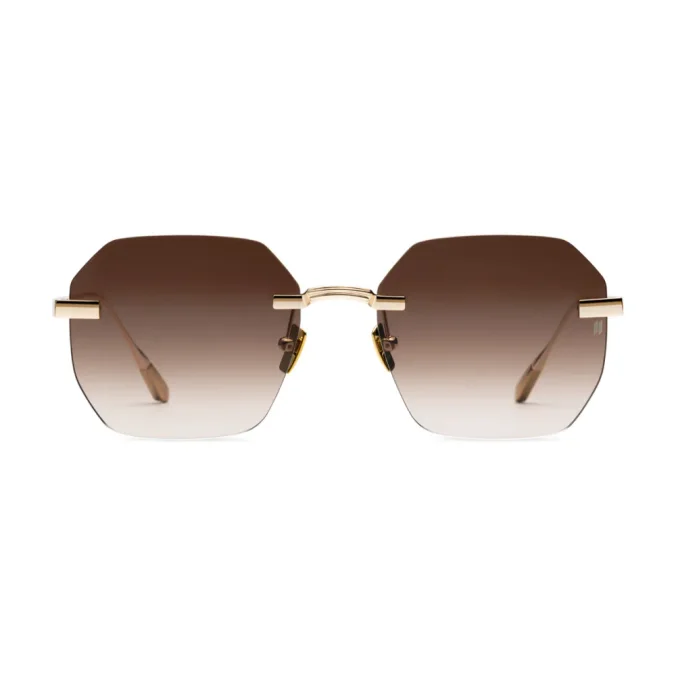
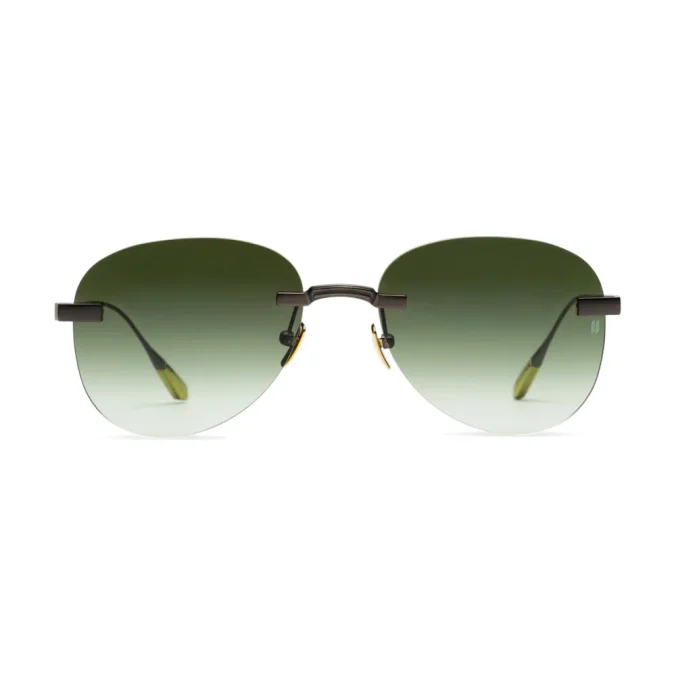
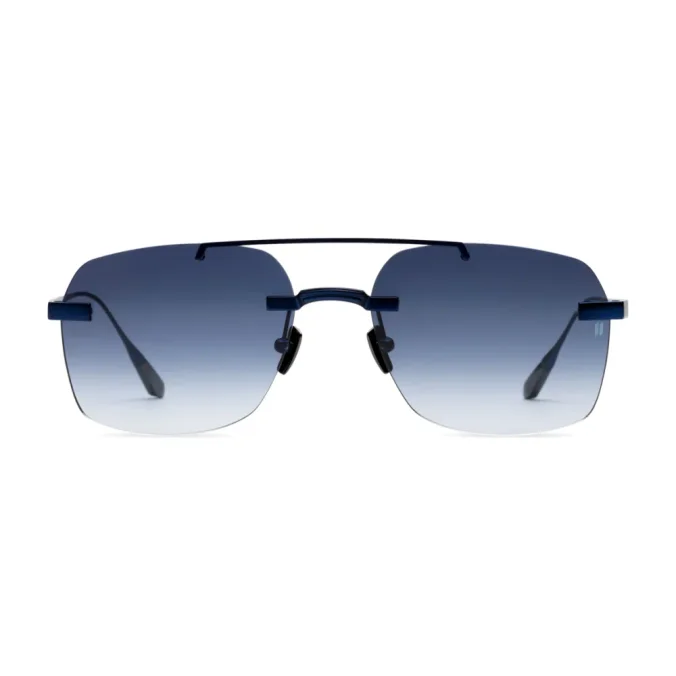
Experience the engineering and optics behind our frames. Premium rimless titanium sunglasses with ZEISS lenses, crafted for absolute clarity.