
Guides & Articles
Lightweight Sunglasses: What Frame Weight Actually Means
How much sunglasses weigh, what sets the number, and why the size of the nose pads matters as much as the grams – with the figures optician sources actually give.
Read more


Guides & Articles
What beta-titanium is, why its crystal structure makes it springier than pure titanium, and what that means for a frame you wear every day – checked against optician training articles and materials research.
Beta-titanium is the alloy we use for every pair of Archē sunglasses. This guide covers what it is, why it behaves the way it does, and where its limits are. The figures come from optician training articles and materials research, linked where they appear. For how it compares with acetate, steel, aluminium and nylon, see our frame materials comparison.
Titanium frames come in three forms, according to the Association of British Dispensing Opticians (ABDO) training article on titanium: pure titanium (about 99.5% titanium), titanium-clad base metal, and titanium alloys. Beta-titanium is the most widely used of the alloys. ABDO puts it at about 75% titanium, combined with aluminium or vanadium. A continuing-education article in 20/20 magazine gives a typical mix of 75% titanium, 22% vanadium and 3% aluminium.

Titanium frames reached the market in the 1980s and 1990s. 20/20 credits beta-titanium with "thinner construction, more flexibility" than pure titanium.
Pure titanium at room temperature has a hexagonal crystal structure. Adding enough elements such as vanadium stabilises a different arrangement, the body-centred cubic "beta" phase that gives the alloy its name. A 2023 review of beta-titanium alloys describes these alloys as having a "notably low elastic modulus": they are less stiff, so they bend further under a given force and spring back.
 Left: the hexagonal structure of pure titanium. Right: the body-centred cubic structure of beta-titanium, with an atom at the centre of the cube.
In a frame, that lower stiffness shows up at the temples. They can be thin and still flex around your head and spring back when you take the frame off. 20/20 notes that this springiness stays with the temples for the life of the frame.
The same review points out the trade-off: lower stiffness generally comes with lower strength. Beta-titanium is springy, not unbreakable.
Frames sold as memory metal, such as Flexon, are a nickel-titanium alloy with 40–50% nickel (20/20). They can be bent much further and still return to shape. Beta-titanium does not do that: it springs back within its elastic range, and a hard enough bend will leave it bent. It also contains no nickel, which matters if you are allergic to it.
Titanium has a specific gravity of 4.5, against 7.9 for stainless steel (20/20). ABDO describes pure titanium as about as strong as steel and about 45% lighter. That strength is what lets a frame use thin wire and sheet, and it is why our Archē frames weigh 17–18 g.
Titanium is not the lightest frame material, though. Aluminium and plastics such as TR-90 nylon are lighter as materials. Our frame materials comparison sets out the numbers, and our guide to lightweight sunglasses covers what weight means on your face.
Nickel is the most common contact allergen. A meta-analysis of 28 studies found nickel allergy in 11.4% of the general population. Beta-titanium contains no nickel (20/20), which is the main reason titanium frames are recommended to people with metal sensitivities.
Titanium is covered by a thin oxide film a few nanometres thick. It is not completely inert: research on titanium implants finds that small amounts of titanium are released into surrounding tissue, with little sign of toxicity.
The parts around the alloy matter too. ABDO notes that screws on titanium frames are almost never titanium, and that temple and nose-pad cores may be other metals. A dermatology review of eyeglass-frame dermatitis records reactions to titanium frames that contained palladium. If you have a nickel allergy, ask what the small parts are made of. Our materials guide shows which parts to ask about.
Metal frames corrode mainly because of the acidity of the wearer's sweat, not its amount, according to ABDO. On nickel and copper alloys it shows as a green deposit.
Titanium's oxide film is what protects it. If the surface is scratched, the film re-forms as long as oxygen reaches it (ABDO); Hanawa (2022) cites measurements of it rebuilding in about 30 milliseconds. 20/20 describes titanium frames as 20 times more corrosion-resistant than Monel or nickel-silver.
Adjusting. Titanium frames can be flexed and formed for fit, but 20/20 warns that a hasty bend can snap the metal at the bend. Opticians adjust titanium cold, in small steps, and use a frame warmer only for the temple ends.
Repairing. A broken titanium frame cannot be soldered like ordinary metal. It has to be laser welded or brazed in an argon atmosphere, and ABDO notes that many makers exchange a broken frame instead. Our 2-year limited warranty covers manufacturing defects.
Daily wear. Thin, light frames that stay springy suit a frame worn for many hours. The Pteron Azure is one example.
Sensitive skin. The alloy is nickel-free. Check the small parts as well.
Long-term ownership. The oxide film and the lasting springiness suit a frame you plan to keep and have adjusted over the years. Our product care guide covers cleaning and storage.
Less suited: if you want bold colour and sculptural shapes, or like to change frames often, acetate is the better choice.
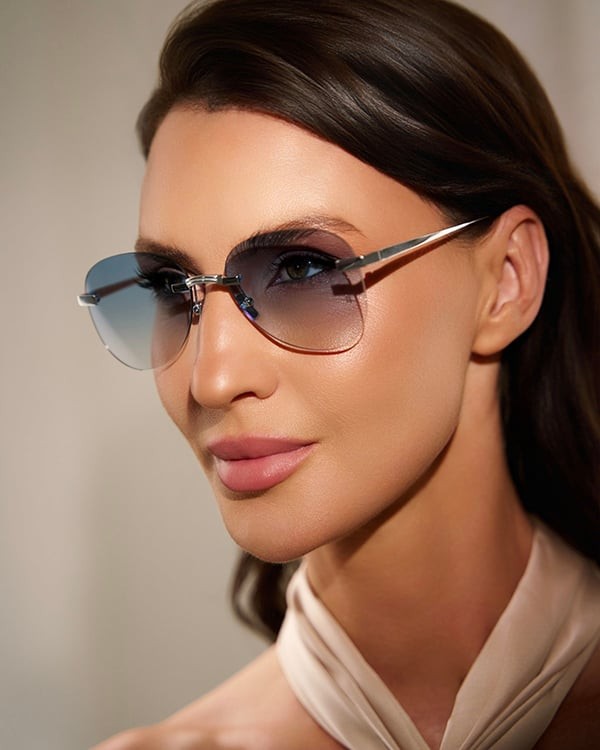
Every Archē frame is fitted with ZEISS lenses with UV protection and a back-surface anti-reflective coating. For fit and proportion, see our guide to frame geometry.
Experience the engineering and optics behind our frames. Premium rimless titanium sunglasses with ZEISS lenses, crafted for absolute clarity.
Continue Reading