Guides & Articles
Lightweight Sunglasses: What Frame Weight Actually Means
How much sunglasses weigh, what sets the number, and why the size of the nose pads matters as much as the grams – with the figures optician sources actually give.
Read more

Guides & Articles
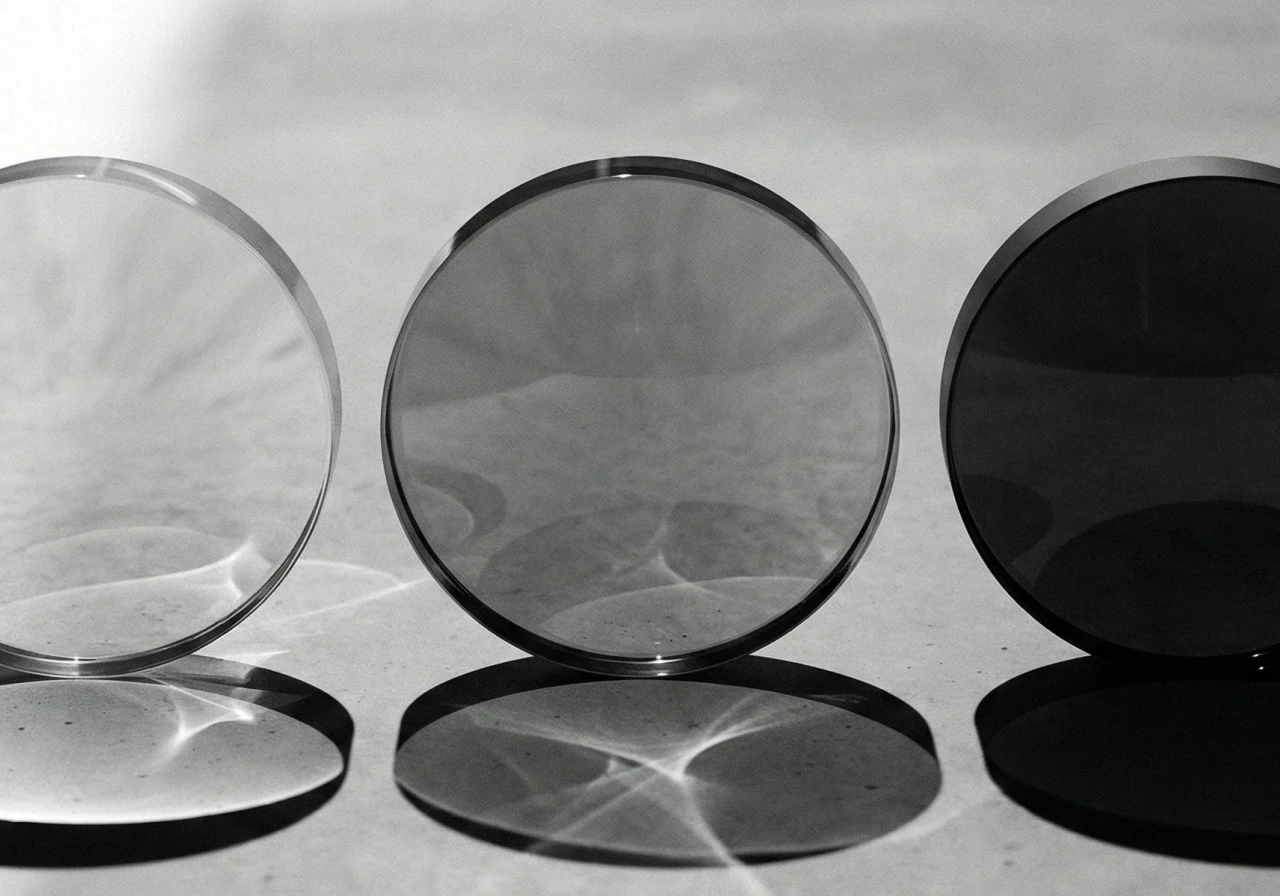
Discover lens categories, VLT transmission, and tint colors. Learn how to choose the perfect lens tint for your environment and lifestyle.
Light shifts with the seasons, the geography, and the hour of the day. A lens that performs perfectly under the harsh midday sun of the Mediterranean may feel too dim for a clouded afternoon in London.
Choosing a lens is about more than looks: it means picking the right filter for your environment. While ZEISS ensures that every lens offers 100% UV protection regardless of its shade, the tint intensity determines visual comfort.
This guide explains lens categories, tint colors and gradients, so you can match a lens to where you wear it.
In optics, the darkness of a lens is measured by Visible Light Transmission (VLT) – the percentage of light that passes through the lens to reach your eye. EN ISO 12312-1 groups lenses into five filter categories by VLT, from 0 to 4. The transmission ranges match the sunglasses fact sheet of the Swiss Federal Office of Public Health, which lists the same categories.
| Category | Symbol | Visible Light Transmission (VLT) | Best Use | UV Protection |
|---|---|---|---|---|
| 0 |  | 80–100% | Indoor, minimal sun | 100% UVA/UVB |
| 1 |  | 43–80% | Overcast, variable weather | 100% UVA/UVB |
| 2 |  | 18–43% | Partly cloudy, transitional | 100% UVA/UVB |
| 3 |  | 8–18% | Bright sunny days | 100% UVA/UVB |
| 4 |  | 3–8% | Intense sun, water, snow | 100% UVA/UVB |
A higher category means more visible light is filtered, not more UV protection – every Archē lens carries the same 100% UVA/UVB filter. Categories 0–3 are allowed for daytime driving; Category 4 is too dark for driving under EN ISO 12312-1.
Archē lenses are Category 2, except the lighter Pteron Azure, Kairos Crystal and Iris Jade, which are Category 1.
Visible Light Transmission: 43% – 80%
The Atmosphere: These lenses feature a subtle, cosmetic tint. They suit low light, overcast days and moving between indoors and outdoors.
The Function: They soften harsh light without obscuring your vision, so they work for people who wear sunglasses as part of their style, whatever the weather.
Ideal For:
Visible Light Transmission: 18% – 43%
The Atmosphere: A balanced, medium tint often found in gradient lenses. This is the versatile middle ground, suitable for variable European weather patterns.
The Function: Ideal for variable weather, typical of spring and autumn in Europe. They reduce glare comfortably but remain clear enough to wear when the sun dips behind a cloud or when driving through shaded avenues.
Ideal For:
Visible Light Transmission: 8% – 18%
The Atmosphere: The classic, deep sunglass tint. This is the standard for high-exposure scenarios where the sun is intense and glare is significant.
The Function: Essential for bright sunlight, beach environments, and summer driving. This category provides maximum glare reduction and visual rest for the eye during extended exposure to intense light.
Ideal For:
Note: Category 4 lenses (3–8% transmission) are too dark for driving and are meant for glaciers and high-altitude snow. For everyday sunglasses, Category 3 is the darkest practical choice. Archē lenses are Category 1 and 2.
For a deeper understanding of why UV protection is independent of lens darkness, see our dedicated guide.
Beyond darkness, the color of the lens changes how you see contrast and color.
Optical Principle: Grey works as a neutral density filter. It reduces brightness evenly across the visible spectrum, without favoring any color.
The Experience: It shows colors as they are, only darker. The world retains its natural color balance without artificial warmth or coolness.
Best For:
Characteristic: You perceive the world as slightly darker, but colors remain authentic and undistorted.
Optical Principle: Brown lenses filter more blue light, which scatters easily and causes haze.
The Experience: With less blue light, contrast rises. The world looks warmer and more defined, especially in haze or flat light.
Best For:
Characteristic: Warmer colors and more contrast.
Optical Principle: Green tints balance color accuracy and contrast. Green lenses keep colors close to grey's neutral view while cutting some blue light, which adds a little contrast.
The Experience: Colors stay natural, with a cooler look than brown and slightly more contrast than grey.
Best For:
Characteristic: Natural colors, between grey's neutrality and brown's contrast.
Many Eleven Spectacles frames have gradient lenses: darker at the top, fading lighter towards the bottom. The gradient changes how the lens works, not just how it looks.
The dark top shields the eye from direct sunlight coming from above, the main source of glare for most outdoor activities.
The lighter lower part keeps vision clear at eye level and below. ZEISS makes its gradient tints lighter at the bottom for easier reading. When driving, you can read the dashboard without lifting the glasses. When indoors or in professional settings, you can read a phone screen or documents without removing your eyewear.
A gradient lens does not completely "mask" the face behind dark glass. Your eyes stay partly visible, so eye contact feels natural in professional and social settings.
A gradient lens in Category 2 or 3 provides the protection of a darker lens where you need it (overhead) while maintaining the practicality of a lighter lens where you need clarity (eye level). For most people it is the most versatile choice.
Different environments demand different optical solutions:
Mediterranean Summer: Category 3 grey or brown – strong glare reduction, with neutral colors (grey) or more contrast (brown). In the Archē collection, the darkest option is a Category 2 grey or brown gradient, such as Pteron Charcoal or Kairos Amber.
Northern European Spring/Autumn: Category 2 gradient – enough tint for sun, still clear when clouds pass.
City, Year-Round: Category 1 or 2 gradient – light enough to wear between indoors and outdoors.
Water and Mountains: Category 3, ideally polarised, which blocks glare from water, roads and ice; glaciers and high snow can call for Category 4 sport lenses. Archē lenses are made for everyday wear, not for these conditions.
The darkness of a lens has nothing to do with its UV protection. Assuming it does is one of the most common mistakes when buying sunglasses.
Switzerland's Federal Office of Public Health puts it plainly: UV protection depends on the material the lens is made of, not on its colour or tint. It is invisible: a clear lens with a proper UV filter blocks 100% of UVA and UVB. A dark lens without one is a real risk: your pupils widen behind it, so unsuitable sunglasses can even increase the UV dose the eye receives.
Every Eleven Spectacles lens is UV400, blocking 100% of UVA and UVB, whatever its category or color. You can choose the tint purely for visual comfort, environment and lifestyle.
No single lens suits every moment. The choice depends on where you are and how you live.
A Category 2 grey or brown gradient for bright summer days, or a lighter Category 1 lens for the city and changeable weather: across the Archē collection, the optical quality and UV protection stay the same.
Choose the lens for your environment, not for UV protection, which every lens already has: for visual comfort, for the look you want, and for the light where you live. Every tint of our Archē sunglasses is fitted with ZEISS lenses engineered to the same optical standard – only the light they let through differs.
And the lens is only half the equation: the frame that carries it determines comfort, weight and longevity. Our guide to beta-titanium frames explains why the material matters as much as the optics.
Experience the engineering and optics behind our frames. Premium rimless titanium sunglasses with ZEISS lenses, crafted for absolute clarity.
Continue Reading